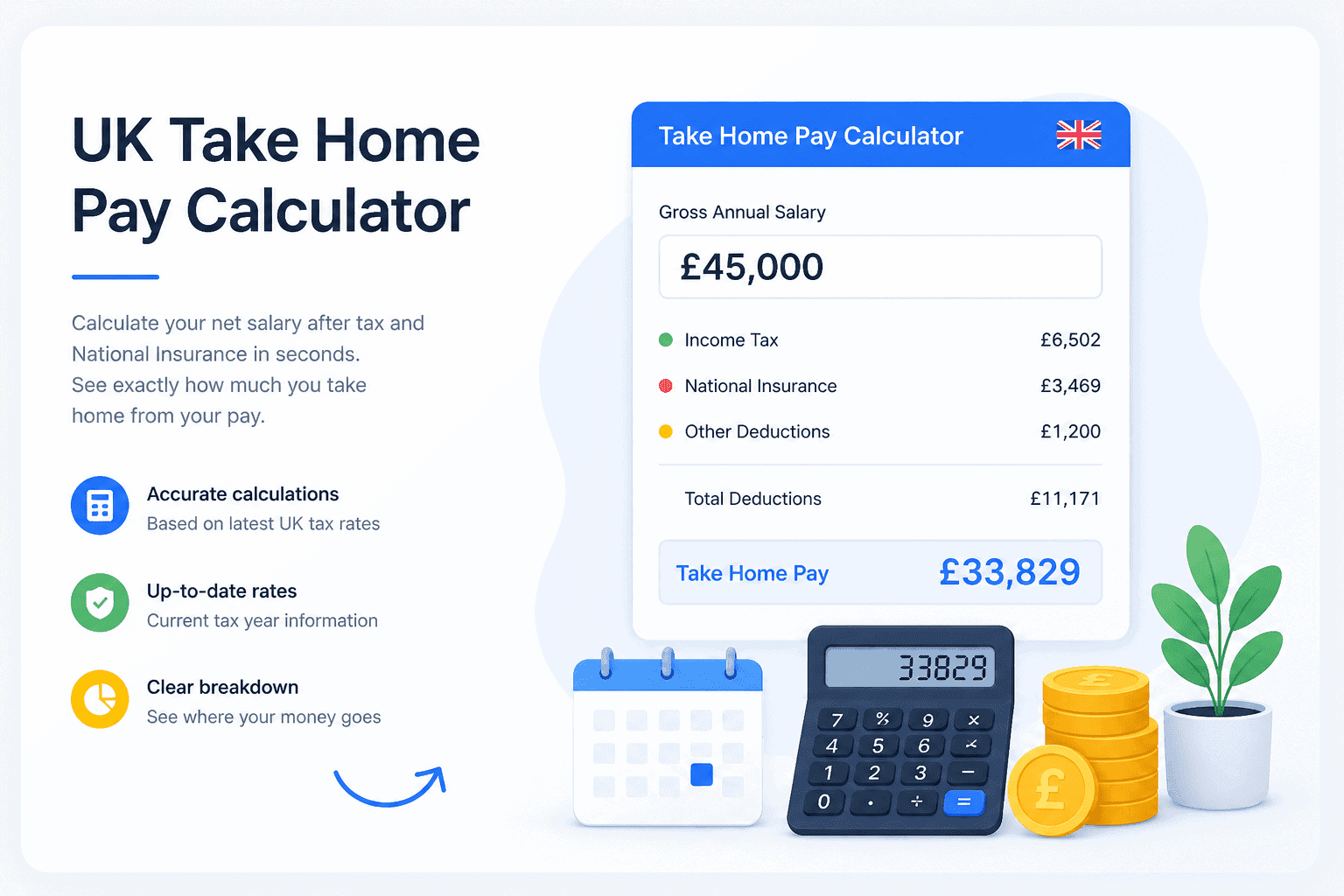
UK Take-Home Pay Calculator 

Your Details

£
£
£
Net Take-Home Pay
£0.00
per year
Pay Distribution
Take-Home Pay
£0.00 0.0%
Income Tax
£0.00 0.0%
National Insurance
£0.00 0.0%
Pension
£0.00 0.0%
Student Loan
£0.00 0.0%
Dividend Tax
£0.00 0.0%
Total Deductions £0.00
Monthly
£0.00
Weekly
£0.00
Daily
£0.00
Based on 2024/25 UK tax rates. For guidance only — not financial advice.
`;const blob = new Blob([html], { type: 'text/html' }); const url = URL.createObjectURL(blob); const a = document.createElement('a'); a.href = url; a.download = 'uk-take-home-results.html'; a.click(); URL.revokeObjectURL(url); });// Wire up all inputs ['salary','bonus','pension','student-loan','employment-type','scottish-tax','dividends'].forEach(id => { document.getElementById(id).addEventListener('input', calculate); document.getElementById(id).addEventListener('change', calculate); });calculate();

What is a take home pay calculator?

A take home pay calculator figures out your salary, which is the total amount of money you will get after everything has been taken out of your gross salary. Your gross salary is the amount of money that you and your employer agreed on when you were hired. The government says that your employer has to take out some money for income tax and national insurance contributions.

Depending on your situation you might also have to pay for student loans and pensions. These will be taken out of your gross salary too. The take home pay calculator does all of these things in the order using the rules for the 2025/26 tax year that HMRC set out which is from 6 April 2025, to 5 April 2026. The take home pay calculator uses the 2025/26 tax year guidelines to make sure everything is correct. It helps you understand how much take home pay you will really get.

Good to know: Salary sacrifice pension contributions are deducted before tax is calculated, reducing your taxable income and lowering both your income tax and NI bills at the same time.

How to Use the Take Home Pay Calculator

Using our calculator takes less than a minute. Here is what to do:

  1. Enter your gross annual salary (or select hourly, daily, weekly, or monthly if that is easier)
  2. Choose your pay frequency — annual, monthly, or weekly
  3. Select your tax code (the default 1257L is correct for most people)
  4. Indicate whether you are enrolled in a pension scheme and enter your contribution percentage
  5. Select your student loan plan if relevant
  6. ClickCalculate— your results appear instantly

Your results will show your gross pay, income tax, National Insurance, student loan deductions, pension contributions, and your final take home pay — broken down annually, monthly, and weekly.

chatgpt image may 5, 2026, 11 24 08 am

How UK Income Tax Works

In the UK, income tax is calculated on a progressive band system. This means you only pay each rate on the portion of income that falls within that band — not your entire salary. For the 2025/26 tax year, the bands in England, Wales, and Northern Ireland are:

Tax BandTaxable IncomeTax Rate
Personal AllowanceUp to £12,5700%
Basic Rate£12,571 – £50,27020%
Higher Rate£50,271 – £125,14040%
Additional RateOver £125,14045%

Example: £50,000 Salary After Tax (2025/26)

If you earn £50,000 per year in the UK, your estimated take-home pay is:

  • Gross salary: £50,000
  • Income tax: ~£7,500
  • National Insurance: ~£5,500

Estimated net pay:

  • Yearly: ~£37,000
  • Monthly: ~£3,080
  • Weekly: ~£710

This can change depending on pension contributions, student loans, and tax code.

Note: Scottish residents pay different income tax rates under the Scottish Rate of Income Tax (SRIT). Our calculator covers England, Wales, and Northern Ireland rates.

National Insurance Explained

National Insurance or NI for short is a deduction from income tax. As an employee in 2025/26 you pay Class 1 National Insurance contributions on your earnings:

  • 0% on earnings up to £12,570 per year (the Primary Threshold)
  • 12% on earnings between £12,570 and £50,270
  • 2% on earnings above £50,270

Your National Insurance contributions help you get your State Pension well as other benefits like Statutory Sick Pay and Maternity Pay.

The 2% higher-rate NI threshold affects salaries above £50,270. If you earn around this level, compare our £50,000 after tax and £55,000 after tax pages to see exactly how the threshold changes your net pay.

Student Loan Repayments in the UK

If you have a student loan, repayments are collected through your employer’s payroll via HMRC — just like tax. The repayment rate depends on which plan you are on:

Plan

Repayment Threshold

Rate

Plan 19% of earnings above £24,990/yr9%
Plan 29% of earnings above £27,295/yr9%
Plan 4 (Scotland)9% of earnings above £31,395/yr9%
Plan 59% of earnings above £25,000/yr9%
Postgraduate Loan6% of earnings above £21,000/yr6%

Our calculator lets you select your student loan plan so your take home pay figure is as accurate as possible. Student loan repayments begin to bite around the £25,000–£30,000 salary range — see our £25,000 and £30,000 after tax pages for detailed examples.

Want to pay less tax? Here’s what to do next

Understanding your take-home pay is a great starting point—but it’s only part of the picture. Once you know how much tax and National Insurance you’re paying, the next step is learning how to reduce your taxable income legally.

There are several HMRC-approved ways to keep more of your earnings, including:

  • Making pension contributions (with tax relief)
  • Using ISA accounts for tax-free savings
  • Taking advantage of salary sacrifice schemes

These strategies can make a noticeable difference to your net income over time.
Read our full guide on how to reduce taxable income in the UK, where we break down practical, real-world strategies you can start using straight away.

Gross vs Net Salary

Gross salary is your total earnings before deductions.
Net salary (take-home pay) is what you receive after tax and deductions.

Understanding this difference helps you:

  • Plan monthly budgets
  • Compare job offers properly
  • Estimate real income accurately

Why This Matters

Understanding this difference helps you make better financial decisions. It gives you a clearer idea of your monthly budget, savings potential, and real income.

If you want a complete breakdown of how salary turns into take-home pay in the UK, read our full guide on Gross vs Net Salary.

Example Salary Calculation

Let us look at a straightforward example. Suppose you earn £35,000 a year with no pension contributions and no student loan. Here is roughly what your deductions and take home pay would look like for 2025/26:

  £35,000 Salary — 2025/26 Estimate

  Gross annual salary                                                                                                  £35,000
  Income tax                                                                                                                  ≈ £4,486
  National Insurance                                                                                                   ≈ £1,794
  Monthly take home                                                                                                   ≈ £2,393
  Annual take home                                                                                                    ≈ £28,720

Note: These figures are estimates based on the standard 1257L tax code. Your actual take home pay may differ depending on your tax code, pension contributions, student loan plan, or any other deductions agreed with your employer.

SALARIES NEAR £35,000 — SEE FULL BREAKDOWNS

Earning closer to the higher-rate tax threshold? Our £55,000 after tax guide shows how deductions change above £50,270, with links to every salary between £60,000 and £70,000.

Final Thoughts

A take home pay calculator is the easiest way to understand your real income after tax. It removes confusion from payslips and helps you see exactly how much money you keep each month.

HMRC Income Tax Source

Income tax rates and allowances used in this calculator are based on official guidance from HM Revenue & Customs (HMRC).

This data is used under the Open Government Licence v3.0 and is applied to estimate UK take-home pay for the 2025/26 tax year. Figures are for guidance only and may differ from actual payroll results.

FAQs 

What is my take-home pay in the UK?

Take-home pay refers to the total amount earned after deducting tax. The taxes that one has to pay in the UK include Income Tax, National Insurance, and at times, pension payments. To get an accurate take-home pay figure, use a UK take-home pay calculator.

How is take-home pay calculated in the UK?

Take-home pay is calculated by subtracting deductions from your gross salary. These usually include:

  • Income Tax based on UK tax bands
  • National Insurance contributions
  • Pension contributions (if applicable)

A reliable calculator uses current rates from HM Revenue and Customs to estimate your net salary instantly.

What is the difference between gross salary and net salary?

Gross salary is your total income before any deductions. Net salary, also called take-home pay, is what you actually receive after tax and other deductions. Understanding this difference helps you plan your finances better and avoid surprises on payday.

What is the percentage of my income that I will be paying as tax?

It depends on how much you earn. In the UK, there is a progressive tax rate system, where the tax payable increases when the income exceeds a certain threshold. There are three categories of tax brackets, including the basic rate, higher rate, and additional rate bands.

Is there any effect of National Insurance on my salary?

Yes, there is an effect of National Insurance on my salary, as it takes away from it. It is a form of tax levied according to one’s salary, which goes toward funding national public programs.