
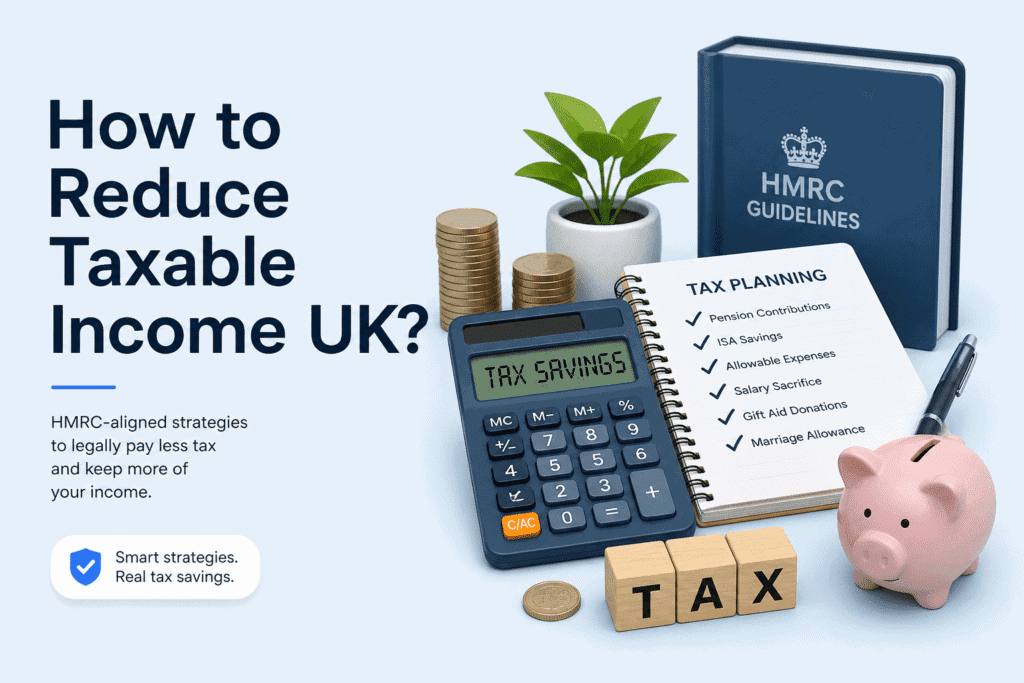
How to Reduce Taxable Income UK?
If you earn in the UK, tax isn’t optional but how much you pay can often be managed. Many people assume their tax bill is fixed, but that’s not quite true. The system allows you to adjust your taxable income legally, using reliefs and allowances provided by HMRC.
This guide cuts through generic advice and focuses on practical, real-world UK tax saving tips, backed by HMRC guidance. Whether you’re employed or self-employed, you’ll see where small adjustments can make a noticeable difference.
UK Income Tax Bands (2025 Overview)
Understanding tax bands is key. You’re not taxed at one flat rate your income is split across bands.
| Band | Taxable Income | Tax Rate |
|---|---|---|
| Personal Allowance | Up to £12,570 | 0% |
| Basic Rate | £12,571 – £50,270 | 20% |
| Higher Rate | £50,271 – £125,140 | 40% |
| Additional Rate | Over £125,140 | 45% |
👉 Income Tax UK explained – HMRC guide on how UK income tax works
Important nuance:
Once income exceeds £100,000, your Personal Allowance gradually reduces. This creates an effective 60% tax zone, which many people overlook.
Understanding Taxable Income
Taxable income is what remains after deductions like:
- Pension contributions
- Allowable expenses
- Certain reliefs
It’s not just your salary. Bonuses, rental income, and freelance earnings all count.
Personal Allowance Optimisation
Most people leave this untouched but it’s one of the easiest wins.
Key Insight
If your income is close to £100,000, even small adjustments (like pension contributions) can restore your Personal Allowance, effectively saving tax at a higher rate.
Practical Example
You earn £105,000:
- Personal Allowance is reduced
- Contribute £5,000 to pension
- Your income drops below £100,000
- You regain full allowance
That’s a double tax benefit, not just a simple deduction.
👉 UK Personal Allowance details – how much tax-free income you can earn
Pension Contributions
This is arguably the most powerful tool available.
Why It Works So Well
- Reduces taxable income
- Provides immediate tax relief
- Supports long-term financial planning
Advanced Insight
Higher-rate taxpayers often forget to claim additional relief via Self Assessment. If you don’t claim it, you’re effectively overpaying tax.
Example
Income: £60,000
Pension contribution: £10,000
Result:
- Taxable income drops to £50,000
- You avoid higher-rate tax on that portion
👉 Pension tax relief UK – how HMRC reduces tax on pension contributions
Salary Sacrifice: Pros & Cons
Salary sacrifice is useful but not always straightforward.
Pros
- Reduces taxable income immediately
- Lowers National Insurance
- Easy to automate through payroll
Cons
- Can reduce mortgage borrowing capacity
- May impact statutory benefits (e.g., maternity pay)
- Less flexibility once agreed
When It Makes Sense
- Pension contributions
- Electric vehicle schemes
- Cycle-to-work schemes
👉 Salary sacrifice explained – HMRC rules and impact on PAYE tax and benefits
ISA Strategy Beyond Basics
ISAs are often explained simply, but there’s more to them.
Deeper Insight
While ISAs don’t reduce taxable income today, they:
- Prevent future tax drag
- Help avoid capital gains tax
- Offer flexibility for withdrawals
Smart Use Case
If you’re nearing higher-rate tax:
- Use pensions for immediate relief
- Use ISAs for long-term flexibility
Self-Employed Expense Strategy
This is where many overpay tax without realising it.
Commonly Missed Claims
- Home office proportion (rent, electricity)
- Software subscriptions
- Training directly related to your business
Strategic Insight
Timing matters. Bringing forward expenses before the tax year ends can reduce your current liability.
👉 Self-employed expenses UK – HMRC rules on allowable business costs
Marriage Allowance
A simple but underused relief.
- Transfer £1,260 of allowance
- Save up to £252 per year
👉 Learn more about Marriage Allowance on GOV.UK
Gift Aid & Smart Giving
Charitable giving can also be tax-efficient.
Advanced Tip
If you’re a higher-rate taxpayer, claiming the difference between basic and higher rate is often forgotten.
👉 Gift Aid UK explained – how charitable donations reduce your tax bill
2025 HMRC Updates (Key Points)
As of current HMRC guidance:
- Tax thresholds remain frozen until 2028
- This means more people are pushed into higher bands over time
- Known as “fiscal drag”
What this means for you:
Even if your salary doesn’t increase significantly, your tax bill might.
Quick Checklist: Ways to Reduce Taxable Income
- ✔ Contribute to a pension
- ✔ Use salary sacrifice where suitable
- ✔ Claim all allowable expenses
- ✔ Check your tax code
- ✔ Use Marriage Allowance if eligible
- ✔ Maximise ISA contributions
- ✔ Claim Gift Aid relief
Using a Take Home Pay Calculator
Before making any decisions, it helps to see the numbers clearly.
A UK take home pay calculator allows you to estimate your net salary after tax, National Insurance, and deductions. It’s especially useful when you’re considering changes like pension contributions or salary sacrifice.
You can naturally guide users here, for example:
“Before adjusting your income strategy, it’s worth checking your actual take-home pay using a UK take home pay calculator to see how different choices affect your net income.”
This keeps the flow helpful and informative without sounding promotional. It simply supports better decision-making.
Compliance & Disclaimer
Legal Compliance
All strategies in this guide are based on HMRC-approved reliefs. They are legal and encouraged when used correctly.
Disclaimer
This article is for general information only and does not constitute financial advice. Tax rules can change, and individual circumstances vary. Consider consulting a qualified accountant or tax adviser before making decisions.
Conclusion
Reducing taxable income in the UK isn’t about clever tricks. It’s about using the system as it’s designed. The biggest gains usually come from pensions, allowances, and how your income is structured.
Once you understand where tax is applied and how reliefs work, the process becomes far more predictable and manageable.
FAQs
How can I reduce taxable income UK quickly?
Pension contributions and salary sacrifice are the most immediate and effective options.
What happens if I earn over £100,000?
Your Personal Allowance reduces, increasing your effective tax rate. Planning becomes more important at this level.
Are ISAs better than pensions?
They serve different roles. Pensions reduce tax now; ISAs protect future income from tax.
Can I reduce tax if I’m self-employed?
Yes, by claiming allowable expenses and using pension contributions effectively.
Is it legal to reduce taxable income?
Yes, as long as you follow HMRC rules and use approved allowances and reliefs.